Biocracked
←

#regulatory status

1 article
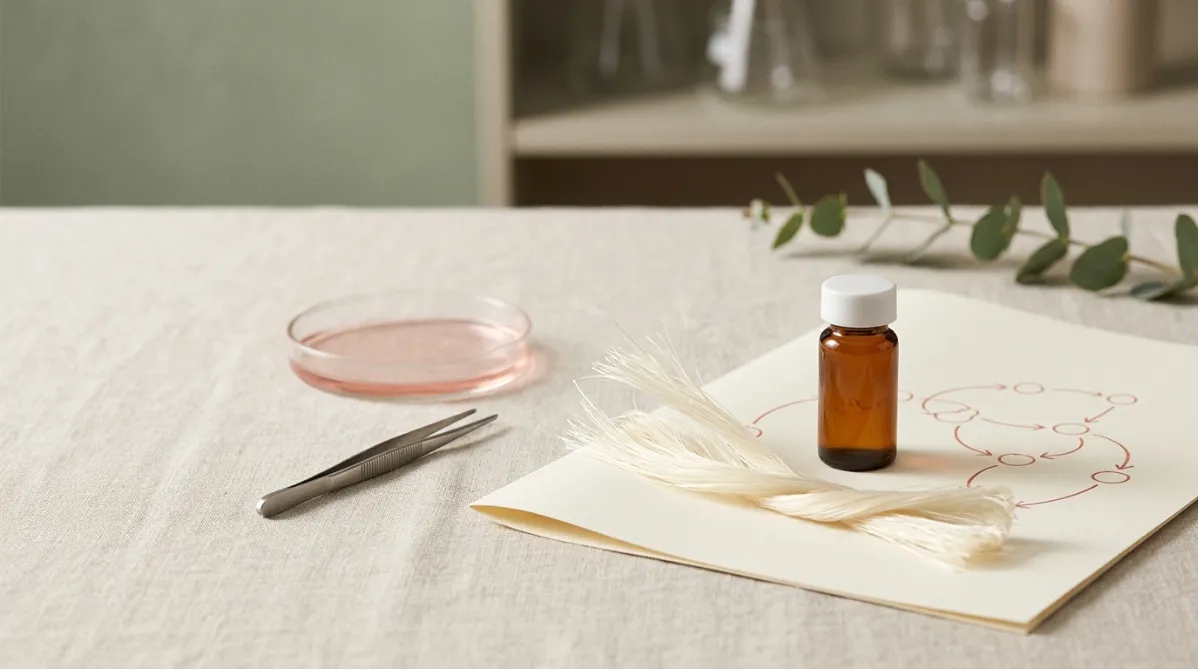
A wide, editorial-style still life photographed in soft natural window light on a pale oatmeal-colored linen surface. In the center foreground, a single small amber glass vial with a matte white cap sits slightly off-center to the right, unlabeled and minimal. Beside it lies a delicate, translucent skein of tendon-like fibers, rendered as fine pale ivory threads gently fanning out and twisting together, resting on a folded sheet of cream paper. To the left, a glass petri dish with a thin layer of soft blush-pink liquid, catching a subtle highlight, and a slim pair of stainless steel tweezers laid diagonally across the surface.

Behind the objects, a softly blurred background in muted sage green and warm taupe suggests a quiet laboratory shelf, with out-of-focus glassware shapes and a single trailing sprig of eucalyptus adding an organic note. A thin, hand-drawn style line diagram of interconnected nodes and curved arrows, in faint terracotta ink, is printed on the paper beneath the fibers. It hints at a cellular signaling pathway without any text or readable labels.

The composition uses generous negative space on the left third for potential title overlay, with a shallow depth of field and a gentle diagonal flow from the petri dish to the vial. The color palette is restrained and warm: cream, sage, blush, amber, and terracotta accents, with soft shadows and a faint film-grain texture. The mood is calm, thoughtful, and scientific but approachable, like a contemporary health and science magazine cover. Shot as if with a 50mm lens at f/2.8, top-down at a slight 30-degree angle, with crisp focus on the vial and fibers. No people, no text, no futuristic elements.
peptides

BPC-157 与肌腱修复:FAK‑Paxillin 研究揭示的内容与未揭示的部分

BY DR. SYNAPSE ·

BPC-157 是网络“疗愈”圈子里流行的 15‑氨基酸肽,其肌腱修复的声誉主要来源于一篇被广泛引用的 2011 年研究。该研究显示它能加速肌腱成纤维细胞的外延、提升在氧化应激下的存活率,并通过激活 FAK‑paxillin 通路促进细胞迁移,但并未直接促进细胞增殖,所有结果均来源于大鼠组织和体外细胞。本文拆解其作用机制,说明为何这并不等同于人体证据,并回顾该肽未获批准的监管状态。

This page is available in